
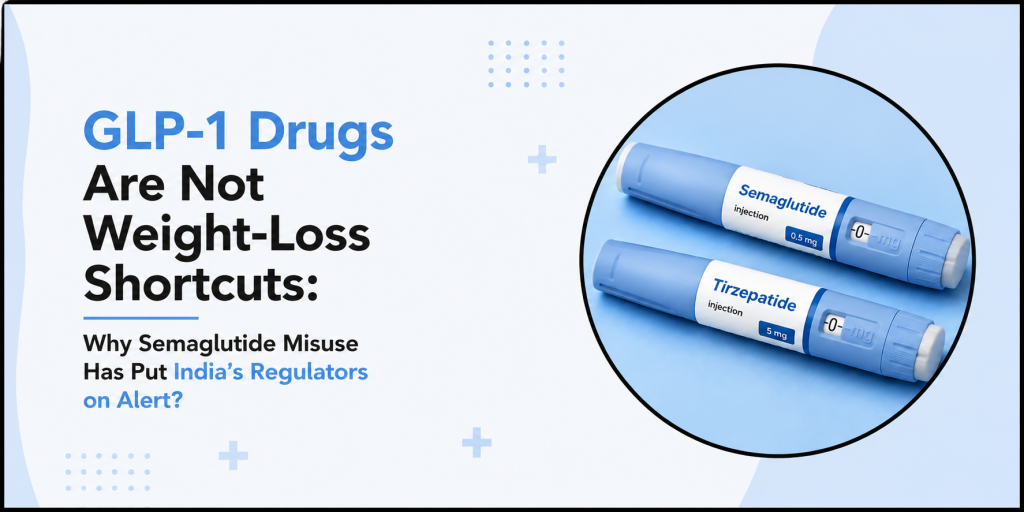
Semaglutide and tirzepatide change the way diabetes and obesity care treat diabetes and obesity with more efficient use, but misuse without prescribed use can be dangerous. This is how India is regulating GLP-1 drugs.
Over the last several years, GLP-1 drugs like semaglutide have gone from diabetes clinics to social media chatter. What was initially created as a scientifically proven treatment for type 2 diabetes and obesity is now frequently advertised as a fast weight-loss strategy. That’s where the trouble begins. These medicines are powerful. They work on hormones controlling blood sugar, appetite, gastric emptying, insulin and glucagon. And when utilized properly, they can be life-changing for chosen individuals. Used casually, without diagnosis, dose titration, monitoring, or prescription, they present serious clinical and regulatory risks.
Why Semaglutide became That Popular?
It mirrors the GLP-1 hormone, which stimulates insulin secretion, suppresses glucagon, slows gastric emptying, and decreases appetite. This is also why it helps in type 2 diabetes and weight loss in obesity. But, as weight loss is apparent and rapid in certain patients, semaglutide is susceptible to abuse. Some may use it for cosmetic weight loss, purchase doses through informal routes, administer wrong amounts, pause and re-take it without supervision.
This is not safe medicine. It is self-experimentation.
GLP-1 medicines can even induce nausea, vomiting, dizziness, dehydration, gallbladder problems, risk of pancreatitis, kidney damage in susceptible patients, and other complications. Even the Government of India has warned expressly that GLP-1 medications should be taken only in clinical supervision, and misuse can lead to severe complications.
The misuse isn’t just on patients. It can occur across the supply chain. Wellness clinics may market these drugs as “fat-loss injections.” Access may be overly easy thanks to some online portals. Some retailers may dispense without a prescription. Certain ads might use “awareness campaigns” or influencer-style content to push prescription drugs indirectly through indirect means.
That’s precisely why GLP-1 drugs have become a regulatory issue and not just a medical issue.
A drug with prescriptions cannot be marketed as a cosmetic product. Treatment of obesity is based on clinical assessment, BMI evaluation, comorbidity review, contraindication screening, diet, exercise and follow-up. Without it, the drug is losing access to the safe system.
How Tirzepatide Changed the Conversation
Tirzepatide, which is known as a next-gen incretin therapy because it acts on two receptors; GIP and GLP-1.
Semaglutide’s central action is via GLP-1 receptor activation and tirzepatide’s GIP and GLP-1 receptor response combined. In numerous patients, this dual action improves glycemic control, appetite regulation, insulin sensitivity, and weight reduction at more potent rates. In a head-to-head obesity trial, tirzepatide achieved significant reduction in weight and waist circumference compared to semaglutide at 72 weeks.
But “better” does not mean “suitable for everybody.” Tirzepatide still needs medical monitoring, dose escalations, side-effect monitoring, and careful patient selection. It provides a stronger tool, not just a shortcut for convenience.
India’s Review of GLP-1 Drugs
India has begun to tighten up its regulatory framework against these drugs. CDSCO has sanctioned drugs such as orlistat, tirzepatide and semaglutide for the treatment of obesity/weight management, but they also must be sold by sale in the retail trade only on prescription, under approval conditions. The Rajya Sabha reply adds that Schedule H, H1, and X drugs are never available on sale without prescription by registered medical practitioner.
India’s Drug Controller General along with State Drug Controllers has also made sure that illegal sale and promotion is prevented through stricter controls. An advisory in March 2023 warned of misleading advertising practices and surrogate marketing of prescription drugs, including GLP-1 receptor agonists. Inspections were also made at online pharmacy warehouses, wholesalers, retailers and weight-loss clinics.
That is, India is treating GLP-1 misuse like a full-chain compliance problem: approval, prescription, sale, advertising, online and clinic use.
What This Means for the Pharma Companies
For pharmaceutical firms, GLP-1 and GIP/GLP-1 drugs are a huge opportunity. But they also need precise scientific and regulatory discipline.Companies moving into this section need to proceed prudently in the following:
Indication and language to the claim are approved. Communication limited to prescription only. Pharmacovigilance and reporting of adverse events. Cold Chain / Storage Compliance.
A comparison of medical education with brand promotion. Evasion of influencer-style / surrogate marketing. Peptide-based formulations quality control. Provide clear evidence for patient information and doctor led use.
This is not a space where aggressive marketing can supplant regulatory maturity.
The Way Forward
Semaglutide and tirzepatide are key breakthroughs in metabolic medicine. When used in accordance with proper medical guidance, they can help users with type 2 diabetes, obesity and cardiometabolic risk.
But the very same drugs can also be dangerous when employed as beauty items, shortcut injections, unsupervised weight-loss hacks.
India’s regulators are sending a loud message: the expanded access will be needed, but misuse will not. The fate of GLP-1 and GIP/GLP-1 agents will rely not just on efficacy, but on responsible prescribing, ethical promotion, quality production, and effective surveillance in its aftermath.
Frontro Pharma provides scientific, clinical, and compliance guidance in advanced metabolic therapies. In a category that is moving so quickly, compliance is not paperwork. It is patient safety.
Faq’s
What is semaglutide?
Semaglutide — GLP-1 receptor agonist for type 2 diabetes and obesity therapy. It keeps blood sugar and appetite in check on its stride.
What is tirzepatide?
Tirzepatide is two of them in one. Tirzepatide acts as a GIP and GLP-1 receptor agonist dual. It operates on two incretin pathways and has exerted impressive effects on blood glucose and weight restriction.
Is tirzepatide better than semaglutide?
Tirzepatide, according to multiple recent clinical trials with better weight reduction and glycemic control than semaglutide, is preferred based on the patient’s condition, indication, tolerance, expense and physician’s judgment.
Why is it dangerous to misuse GLP-1 drugs?
If lifestyle and medical monitoring is ignored, misuse can present with side effects, dehydration, wrong dose escalation, risk of pancreatitis, gallbladder complications, poor long-term results.
How does India regulate these medications?
GLP-1 drugs are prescription medicines in India. State Drug Controllers and CDSCO monitor approval, sale, promotion, prescription conditions and unauthorized marketing or dispensing.

