
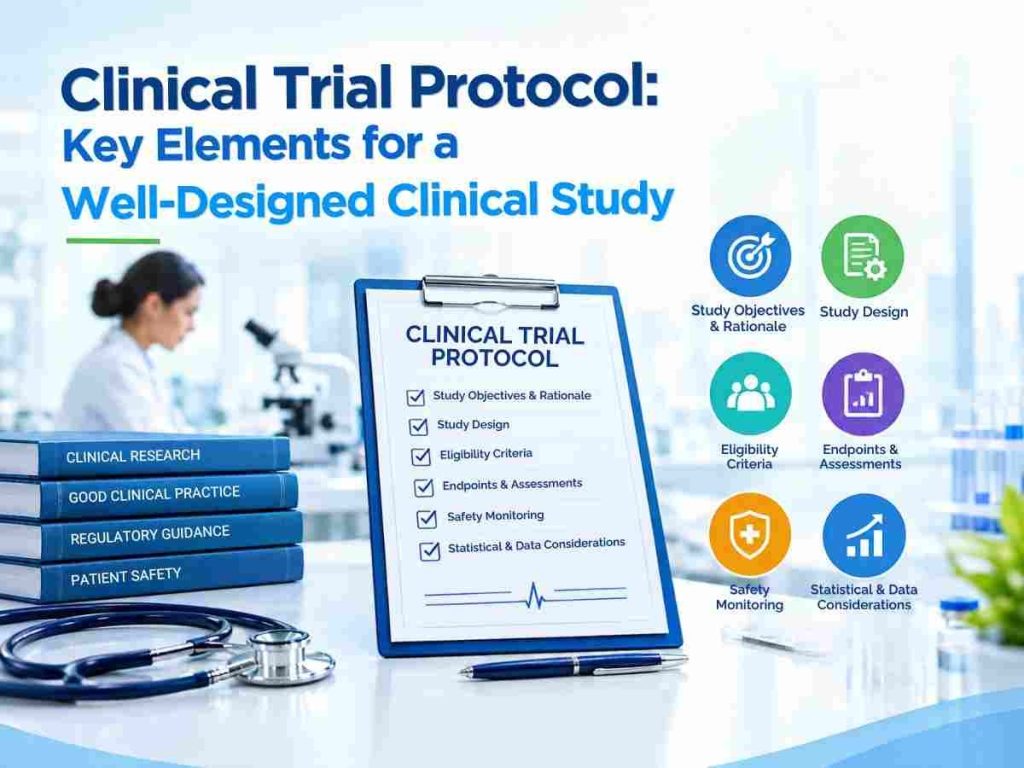
A clinical trial doesn’t start when the first participant is enrolled — it starts with a plan (a well-defined plan) that describes what the study will investigate, who will participate in the study, how the study will be conducted, what data will be collected and how those results will be evaluated. This plan is called a clinical trial protocol.
A good protocol provides a common framework for sponsors, investigators, study teams, ethics committees and other stakeholders. ICH Good Clinical Practice guidance states that a trial protocol should be clear, scientifically sound and operationally feasible; FDA expects a protocol for each planned clinical study .
What Is a Clinical Trial Protocol?
A clinical trial protocol is the document that describes the design and methodology of a clinical study. It translates scientific research questions into structured plans which can be implemented and evaluated.
Depending on the study, the protocol may describe investigational products, study objectives, participant population, eligibility criteria; treatment or intervention, procedures, assessments, endpoints, safety monitoring, data handling and statistical considerations.
The protocol should not contain just scientific information — it has to be practical enough for investigators and study teams to know what needs to happen when, and how it needs to be documented.
Why Is the Protocol So Important?
The quality of a clinical study is strongly linked to the quality of its planning. A poorly defined protocol leads to inconsistency between sites, data interpretation problems and increases possibility of deviations from protocol.
A well-developed protocol helps:
- Set scientific objectives.
- Define participant selection criteria.
- Standardize study procedures.
- Specify safety monitoring requirements.
- Define endpoints and assessments relevant to the study.
- Ensure consistent data collection.
- Define responsibilities for study execution.
- Basis for regulatory and ethical review.
FDA specifically states that “trial design, patient selection, clinical procedures, laboratory tests, safety monitoring and efficacy assessment should be clearly described in clinical protocols”.
Key Components of a Clinical Trial Protocol
The structure may vary depending on the study but some elements are especially important:
1. Study Objectives and Rationale.
The protocol should state why the study is being done and what it intends to determine. Objectives should be specific enough so that study design (study type), endpoints and assessments can be selected; scientific rationale should also establish a basis for investigating intervention and how proposed study answers research questions.
2. Study design.
The protocol should describe the overall design of the trial (treatment groups, control arrangements, randomization, blinding, duration etc.) as well as study setting where relevant (if applicable). The design must be scientifically appropriate but practical for investigators and participants.
3. Participant eligibility.
Inclusion and exclusion criteria should be well defined so that only participants who are appropriate for the study are included (age, diagnosis, disease characteristics, previous treatment, laboratory parameters relevant to disease, medical conditions). Well-considered eligibility criteria can also influence recruitment and applicability of findings from studies.
4. Endpoints and Assessments.
Endpoints specify what outcomes will be measured to evaluate study objectives (protocol should describe measurements relevant to endpoints, assessment methods and timing). For example a study may measure clinical outcomes, laboratory parameters, imaging findings, biomarkers or patient-reported outcomes depending on its research question.
5. Safety Monitoring.
Safety must be built into the protocol from the beginning. Safety procedures might include adverse-event collection, laboratory monitoring, stopping rules, dose modification criteria and escalation if appropriate. For early stage studies FDA recommends detailed safety assessments, toxicity monitoring and predefined stopping or dose adjustment rules.
6. Statistical and data considerations.
A protocol should describe how the study data will be analyzed and justify elements like sample size and statistical methodology (because collecting data without an analysis strategy makes it difficult to answer the original research question).
Protocol Development Requires Scientific and Operational Thinking
Writing a protocol isn’t just putting clinical information into a document — the proposed methodology has to work in real world study conditions.
A good protocol asks questions such as:
- Can investigators do the procedures consistently?
- Are the assessments practical?
- Can participants realistically complete the visits required?
- Will collected data answer study objectives adequately?
These are especially important for complex studies, decentralized approaches, real-world data sources or innovative trial designs.
ICH guidance also says protocol design must be fit for purpose and specific methodologies need to be adequately described and justified.
When Should Sponsors Consider Professional Support?
Sponsors planning a clinical study may need support with protocol development, scientific documentation of study methodology, regulatory considerations, statistical planning etc.
An experienced clinical trial company can help sponsors develop protocols with both scientific and operational thinking in mind. The right support can be particularly useful when the study has a complex intervention, a specialized population, multiple assessments or specific regulatory requirements.
You don’t want to just write a long protocol — you want to produce a clear scientifically justified workable study plan that allows for consistent execution and reliable data generation.
Modernizing Clinical Trial Protocol Development
Clinical research is moving toward standardized and structured development of protocols. In 2026, FDA finalized its M11 guidance on electronic clinical trial protocol structure, template and technical specifications. The initiative aims to standardize content of protocols and electronic exchange between sponsors, regulators, ethics oversight bodies and investigators.
This evolution makes it clear that a clinical trial protocol is not an administrative document — it’s part of the scientific and operational framework of the study itself.
Develop a Clearer Clinical Trial Strategy with FrontroPharma
Pharmaceutical, biotechnology and research organizations need to coordinate scientific objectives with study methodology, documentation and regulatory expectations when planning clinical research.
FrontroPharma offers CRO and research support services to organizations working on pharmaceutical and healthcare research projects.
If you are planning a clinical research project and need professional help in protocol development or other related research activities please contact FrontroPharma to discuss your needs and what approach is right for your project.

