
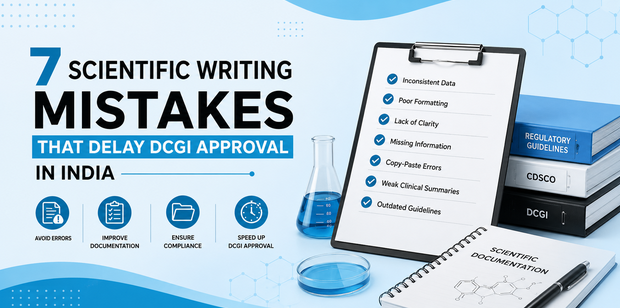
Obtaining DCGI approval is a critical step in pharmaceutical product development. However, many companies face delays because of poor scientific writing in India and incomplete regulatory documentation.
Errors such as inconsistent data, weak clinical summaries, and formatting issues can lead to regulatory queries and extended approval timelines.
In this article, Frontro Pharma explains the most common scientific writing mistakes that delay DCGI approval in India and how pharmaceutical companies can avoid them.
Why Scientific Writing Is Important in Pharmaceutical Regulatory Affairs
Scientific writing in India is not simply documentation; it is a systematic method of expressing scientific and regulatory data accurately.
Some of the applications of scientific writing include:
- regulatory filing,
- documenting clinical trials,
- product registration,
- product safety,
- and pharmaceutical product development.
Good scientific writing ensures that the reviewer of any regulatory agency understands:
- product safety,
- product efficacy,
- product quality, and
- compliance with CDSCO and DCGI regulations.
Bad documentation may lead to complications and may cause delays in the entire process.
That is why pharmaceutical industries today are increasingly turning towards CROs and regulatory affairs consultancy firms to provide scientific writing services in india.
1. Inconsistent Data Across Documents
Inconsistencies in data across regulatory documents are among the most frequently made errors in scientific writing.
Some instances include:
- Batch number inconsistency,
- Dosage inconsistencies,
- Patient number discrepancy,
- and stability data discrepancies.
Regulatory authorities analyze information contained in all submitted documents for consistency. The slightest inconsistency can lead to questions about data validity and document integrity.
Example
If the manufacturing document indicates one strength but the clinical trial document reports another, the regulatory body will request further clarification.
How to Avoid This Mistake
- Ensure accurate data management processes.
- Consistency verification prior to submission.
- Scientific review processes.
Consistent scientific writing prevents unnecessary regulatory inquiries.
2. Poor Formatting and Document Organization
A scientific paper should have correct regulatory formatting.
Submissions that lack appropriate formatting will contain:
- inconsistent headings,
- numbers not assigned to each section,
- improper tables,
- and poorly structured document organization.
Disorganization of a dossier makes the work of the regulator challenging and reduces its credibility.
Why Formatting Matters
Regulators have a lot of documents to examine. Correct formatting makes the examination process easy for regulators.
Good regulation professionals check whether the document adheres to proper formatting.
3. Lack of Scientific Clarity
Clarity is the primary requirement of any piece of scientific writing.
Some examples of uncertainty in scientific writing are:
- conclusions lacking clarity,
- inadequate explanation of methodology,
- heavy use of technical terms, and
- inadequate explanation of data interpretation.
The aim of scientific writing is to present complicated information in simple and clear language.
Example
Summary of a clinical trial which does not clarify endpoints may cause problems for reviewers.
Best Practice
Use:
- succinct language,
- summary writing,
- clear conclusion, and
- proper terminology.
4. Missing Regulatory Compliance Information
Non-compliance in regulatory documentation is one of the leading causes of delays in DCGI approval.
Such documentation may lack:
- stability tests,
- validation tests,
- bio-equivalency results,
- manufacturing information,
- or safety information.
The non-provision of required documents leads to queries from regulatory bodies.
How to Improve Compliance
To enhance compliance, pharmaceutical manufacturers need to:
- keep an eye on CDSCO requirements,
- comply with DCGI regulations,
- and perform compliance checks before filing their application.
Professional regulation affairs consultancy services can help here.
5. Copy-Paste Errors in Scientific Writing In India
Surprisingly, such errors are fairly frequent in the context of pharmaceutical writing.
For instance:
- wrong product name,
- outdated literature citation,
- inconsistency in study data,
- or wrong formulations description.
Such errors decrease the validity of your submission and cast doubt on your quality control measures.
Case Study
The use of an outdated product name can result in extra scrutiny of your submission and delays in the approval process.
Best Practice
All scientific documents must pass through:
- quality assurance checking,
- technical editing,
- and scientific proofreading prior to submission.
6. Weak Clinical Study Summaries
Clinical study summaries are crucial parts of any drug regulatory submission.
Commonly, inadequate summaries lack:
- important end points,
- interpretation of the study findings, or
- appropriate interpretation of clinical data.
- Low-quality clinical writing can have adverse effects on clinical trial management and submission reviews by regulators.
The Importance of Clinical Writing
Regulators use clinical summaries in assessing product’s:
- safety,
- efficacy, and
- risk-benefit ratio.
Good summaries ensure high-quality submissions and increase the confidence of regulators.
CRO Services in Professional Medical Writing
Professional CROs assist their clients in:
- clinical study reports,
- investigator brochures,
- safety narrative, and
- other clinical writing services.
7. Failure to Follow Updated Regulatory Guidelines
Regulatory standards keep on updating within the pharmaceutical industry.
Following old regulatory standards may lead to:
- Non-compliance within submissions,
- Requesting for further clarifications,
- Or even a rejection of your dossier.
Pharmaceutical firms should stay up-to-date with regard to:
- CDSCO notification updates,
- DCGI guidelines updates,
- And pharmaceutical regulations of India.
- Recommendation
Consultancy experts in pharmaceutical regulatory affairs help maintain compliance.
Recommendation
Working with pharmaceutical regulatory affairs consultancy experts helps companies remain compliant with evolving submission requirements.
8. Poor Use of Scientific References and Citations
Scientific citations improve the credibility of pharmaceutical literature.
Examples of poor referencing practice can be:
- citing outdated information,
- incomplete citations,
- baseless assertions,
- or inaccurate scientific citations.
The regulatory authorities should have scientific evidence through credible sources in scientific writing.
Ideal Practice
Always employ:
- up-to-date scientific citations,
- credible scientific information, and
- accurate referencing.
Good scientific citations improve document credibility.
9. Lack of Quality Control Before Submission
Most pharmaceutical organizations do not have rigorous quality control measures prior to finalizing their submission documents.
Without thorough quality control measures, the document might contain:
- grammar mistakes,
- formatting discrepancies,
- technical inaccuracy,
- and even omission of some parts.
Why Quality Review Matters
A final quality check ensures that all mistakes are detected prior to the start of regulatory evaluation.
In Frontro Pharma, our team performs quality controls in science, technology, and regulation.
10. Misunderstanding the Role of Professional Scientific Writing
Most pharmaceutical companies continue to consider scientific writing as a secondary role instead of a strategic regulatory activity.
But bad scientific writing could lead to:
- extended approval time,
- low-quality submissions,
- regulatory issues, and
- product launch delays.
Professional scientific writing solutions enhance:
- documentation quality,
- regulatory preparedness,
- regulatory communications, and
- approval success rates.
This is the reason why top pharmaceutical companies are now collaborating with professional scientific writing CROs and regulatory affairs consulting firms.
DCGI Scientific Writing Checklist
Before sending your pharmaceutical documents, make sure that:
✅ Consistency is checked in all sections
✅ CTD and eCTD formats are reviewed
✅ Scientific references and citations are accurate
✅ Updated guidelines by CDSCO are adhered to
✅ Clinical study summaries are checked thoroughly
✅ Quality check is done scientifically and technically
✅ Manufacturing details are correct
✅ Regulatory review is done
Following this checklist will greatly help in reducing errors in the documentation process.
How Professional Scientific Writing Services Benefit Pharmaceutical Firms
Professional scientific writing services assist pharmaceutical firms with:
- regulatory documentation,
- management of clinical trials,
- pharmaceutical product development,
- and regulatory compliance.
At Frontro Pharma, our range of services includes:
- regulatory and scientific writing,
- pharmaceutical regulatory affairs consultancy,
- clinical documentation assistance,
- CTD and eCTD dossier preparation,
- clinical trial management,
- and pharmaceutical product development.
We strive to ensure that pharmaceutical firms develop documentation that is accurate and ready for approval.
Conclusion
Scientific writing is an essential part of a successful submission of any pharmaceutical to its regulatory authorities. Errors even in documentation may cost more time in terms of delays, queries, and inefficiency in obtaining approval.
Hence, by using scientific writing in India and regulatory affairs consulting services, pharmaceutical organizations will not only enhance their submission, but also ensure adherence to regulations and quick approvals from DCGI.
If you seek assistance in scientific writing and pharmaceutical regulatory affairs consultancy services, Frontro Pharma can assist you through your regulatory process.
Faq
What is scientific writing in the pharmaceutical industry?
Scientific writing consists of creating technical and regulatory reports that are necessary for the purposes of conducting pharmaceutical research and performing clinical trials.
Why is scientific writing relevant to the approval by DCGI?
Scientific writing allows presenting pharmaceutical information more accurately and effectively, thus accelerating the process of regulatory approval.
What are the most frequent mistakes in scientific writing?
Typical mistakes include:
- inconsistent data,
- poor formatting,
- weak clinical summaries,
- copy-paste errors,
- and missing regulatory information.
How can pharmaceutical firms make regulatory reports better?
Regulatory documentation may be improved due to:
- updated guidelines usage,
- scientific writing, and
- assistance from professional pharmaceutical regulatory consultants.

