
Finding a promising molecule isn’t enough to develop a new drug — before a medicine can reach patients, researchers need evidence about safety, dosage and effectiveness as well as overall benefit-risk profile. Clinical trials are done in stages so these questions can be answered systematically.
If you are a pharmaceutical or biotechnology company planning a clinical development program then knowing what are the phases of clinical trials will help plan studies, timelines, regulatory requirements and clinical research support more effectively.
In India, the Central Drugs Standard Control Organisation (CDSCO) processes applications for Phase I, Phase II, Phase III and Phase IV clinical trials under New Drugs and Clinical Trials Rules 2019.
What Are the Phases of Clinical Trials?
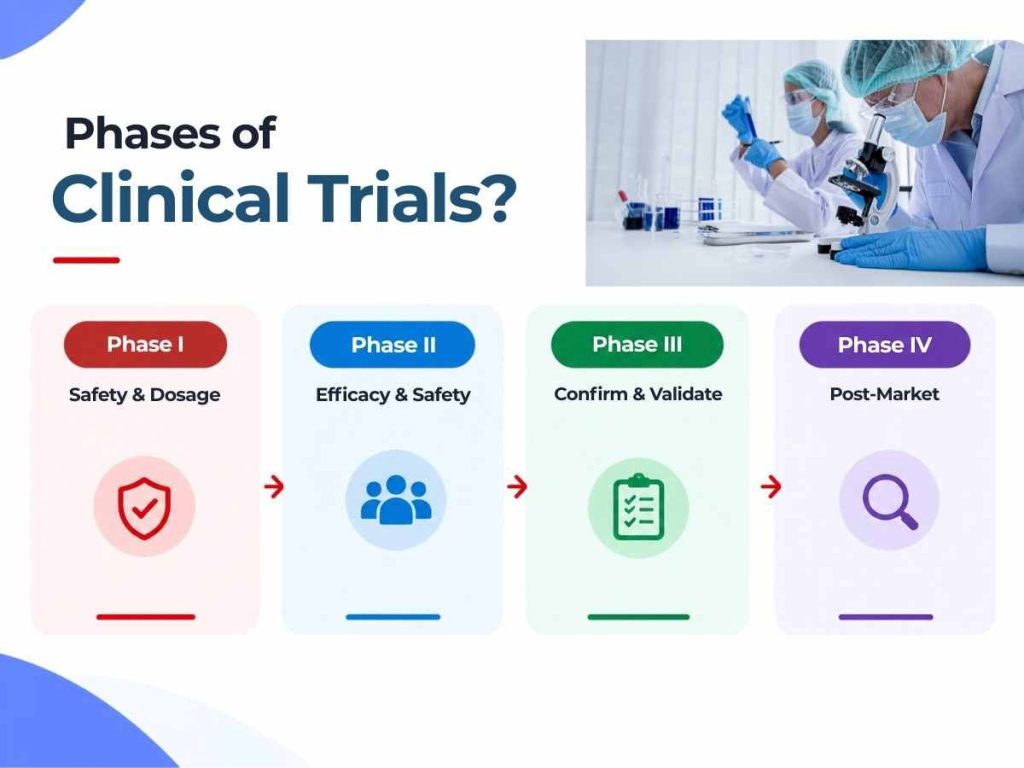
Clinical trials are usually divided into four phases:
- Phase I – Safety and dosage evaluation.
- Phase II – Preliminary efficacy and continued safety evaluation.
- Phase III – Confirmatory efficacy and safety evaluation.
- Phase IV – Post-marketing monitoring.
Each phase has a different purpose and evidence for the next stage.
Phase I Clinical Trials: Is the Drug Safe?
Phase I is usually the first step in testing an investigational drug in humans. Safety, tolerability, dosage, pharmacokinetics (how the drug moves through the body) and how it behaves in the human body are learned in Phase I.
These studies are usually done in a small group (healthy volunteers or patients). Depending on the drug and indication they may be healthy volunteers or patients.
Key objectives of Phase 1
- Evaluate initial safety and tolerability
- Determine appropriate dosage ranges
- Study pharmacokinetics and pharmacological effects
- Monitor adverse events
- Gather information that supports the design of later studies
Pharmaceutical companies care about Phase I planning because the results tell them how to test their investigational product in larger patient populations.
Phase II Clinical Trials: Does the Drug Show Promise?
After initial safety information is available, Phase II studies generally involve patients with the disease or condition being studied. The focus shifts toward obtaining preliminary evidence of efficacy while continuing to evaluate safety and short-term risks.
Researchers may also investigate different doses, treatment regimens and study endpoints.
Key objectives of Phase II
- Evaluate preliminary efficacy
- Continue safety assessment
- Explore appropriate dosage and treatment schedules
- Monitor adverse reactions
- Generate data for designing larger Phase III studies
Phase II therefore acts as an important bridge between early human safety research and larger confirmatory trials.
Phase III Clinical Trials: Confirming Safety and Efficacy
Phase III trials are generally larger studies conducted after preliminary evidence of effectiveness has been established. They provide additional information about efficacy, safety and the overall benefit-risk relationship of the investigational treatment.
Because these trials can involve hundreds or thousands of participants, they typically require substantial planning, operational coordination, data management and monitoring.
For studies conducted in India, regulatory requirements under the applicable Indian framework need to be considered during clinical trial planning. CDSCO’s framework specifically covers approval of Phase I, II, III and IV clinical trials.
Phase IV Clinical Trials: What Happens After Approval?
Phase IV studies are conducted after a medicine has received marketing approval. They are commonly associated with post-marketing surveillance and continued evaluation of safety and effectiveness in broader real-world use.
These studies can help generate additional information about the medicine’s performance, safety profile, longer-term use and other questions that may arise after commercialization.
CDSCO also recognizes Phase IV clinical trials and active post-marketing surveillance studies within its regulatory framework.
Clinical Trial Phases at a Glance
Phase | Main Focus | Typical Purpose |
Phase I | Safety & dosage | Understand how the drug behaves in humans |
Phase II | Efficacy & safety | Assess preliminary effectiveness in patients |
Phase III | Confirmatory efficacy & safety | Generate larger-scale evidence |
Phase IV | Post-marketing monitoring | Continue evaluating the medicine after approval |
The exact design, participant numbers, endpoints and duration can vary depending on the investigational product, disease area, study objectives and regulatory requirements.
Why Choosing the Right Clinical Research Partner Matters?
Getting a drug through clinical development requires coordination between protocol development, regulatory activities, clinical operations, site management, patient recruitment, safety reporting, data management and statistical analysis.
For pharma and biotech companies an experienced CRO company can provide clinical research expertise as well as operational support during development.
A good clinical research partner can help sponsors plan studies around development goals but also take scientific, regulatory and quality considerations into account.
Clinical Trials in India: What Sponsors Should Consider
India has a regulatory framework for clinical trials under New Drugs and Clinical Trials Rules, 2019 (CDSCO framework). The authority processes applications for clinical trial as well as requirements pertaining to investigational products and clinical research.
Sponsors planning clinical trials in India thus need to consider regulatory pathway, study population, therapeutic indication, protocol requirements, site capabilities and operational strategy before starting a trial.
Planning Your Clinical Development Program
Learning about the phases of clinical trials is the first step in planning a structured clinical research plan — safety evaluation (Phase I); post-marketing studies (Phase IV) — all yield information that tells us how safe and effective a medicine is.
For pharmaceutical and biotechnology companies planning clinical research in India, FrontroPharma can offer expertise at different stages of drug development for clinical research programs. A good development strategy will link scientific, operational and regulatory requirements as an investigational product moves through clinical development.

